fast-mafft
A drop-in replacement for MAFFT, the standard multiple sequence aligner, that runs 9.7–36× faster on 32 cores with byte-identical output.
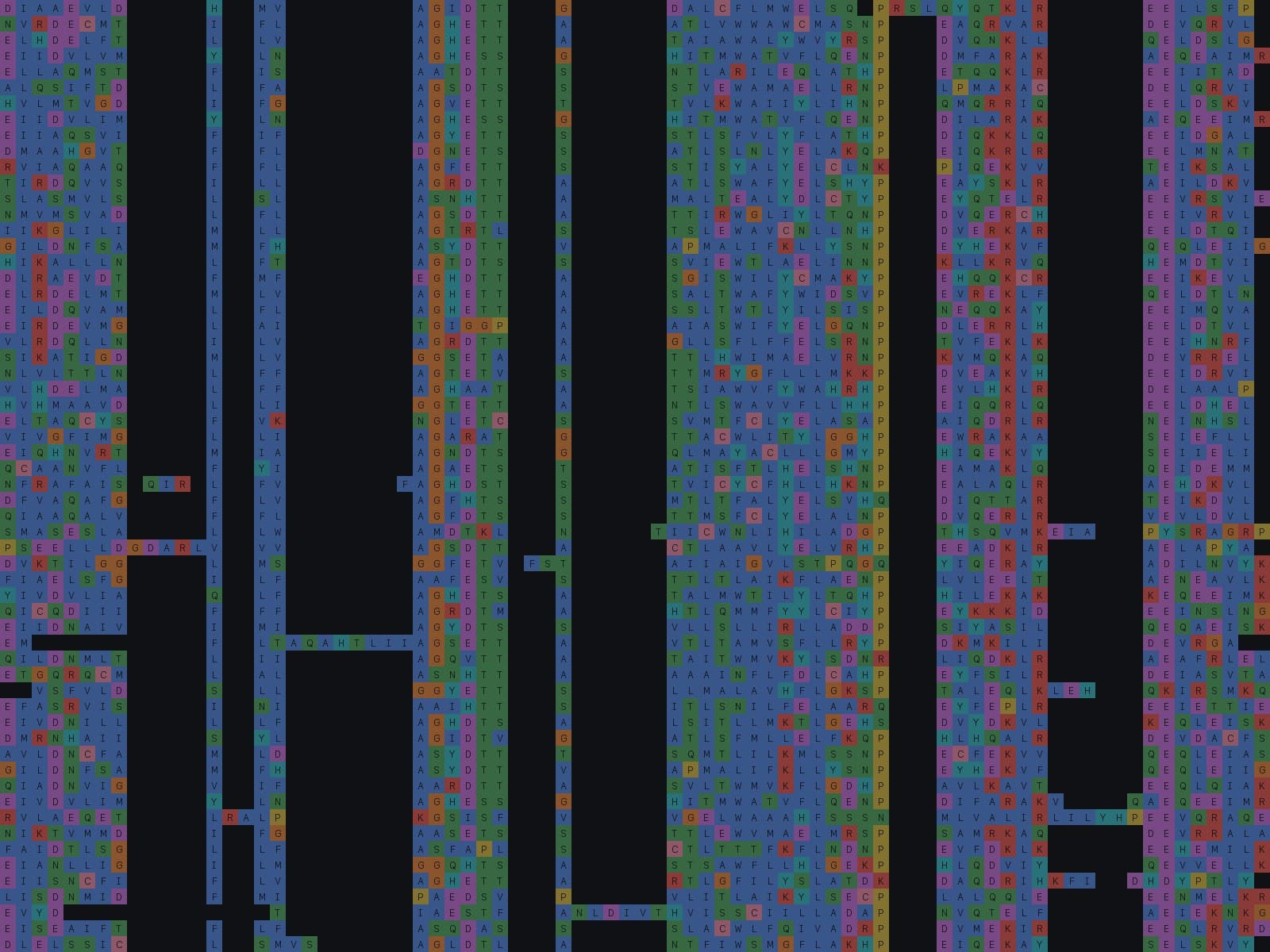
MAFFT is one of the standard tools for multiple sequence alignment: give it thousands of DNA, RNA, or protein sequences and it lines them up so related positions share a column. fast-mafft is a faster drop-in replacement for MAFFT v7.526 in its default mode (FFT-NS-2), built for the USC CSCI 270 bonus project. The constraint was that none of the speed could change the answer: for the same compiler and flags, its output is byte-identical to MAFFT's.
Every stage was rewritten in C. The 6-mer distance step uses a SIMD sum-of-absolute-differences identity, inverted indexes, and bit masks. The guide tree keeps MAFFT's greedy clustering but uses candidate lists to certify most nearest-neighbour rescans. The progressive passes run branch-free, AVX2-vectorized Gotoh DP rows, schedule merges along the critical path, let idle threads tile large DPs, and stay threaded above 20,000 sequences, where MAFFT goes serial. Floating-point values come from the same operations in the same order, and each new kernel has a bitwise self-check against the original code.
On USC's CARC cluster (32-core AMD EPYC, 64 GB), against MAFFT built with -O3 -march=native -flto, fast-mafft ran 9.7× to 36× faster on average across 12 datasets of up to 93,681 sequences, and its slowest single run was still 8.3× faster. The largest RNA set went from 42 minutes to 88 seconds. Output was byte-identical in all 36 timed runs and on all 386 BAliBASE cases.
stack
C · AVX2 SIMD · pthreads · Dynamic Programming · Performance Engineering · Bioinformatics · HPC · Slurm